
Alzheimer's Disease
West Los Angeles · Memory & dementia care
Compassionate Care for Families
Alzheimer's disease is a progressive neurological disorder that affects memory, thinking, language, and behavior. Symptoms may develop over 5 to 20 years and require thoughtful, family-centered care.
Our team provides thorough evaluation, clear communication, and ongoing management plans tailored to each stage of the disease.
What Is Alzheimer's?
How the disease affects memory, thinking, and daily function over time.
Explore →Causes & Changes
Brain changes, amyloid plaques, and factors that may contribute.
Explore →Common Symptoms
Early signs families notice and when to seek evaluation.
Explore →FAQ
Answers about diagnosis, care planning, and our approach.
Explore →
Memory, thinking, and behavior change as Alzheimer's affects the brain over time
A progressive neurological disorder
What Is Alzheimer's Disease?
Alzheimer's attacks brain tissue. Its hallmark is steadily increasing memory loss, along with changes in vision, language, and emotional control as nerve cell connections decline.
Symptoms often develop gradually over years. Early signs may include trouble learning new information, misplacing objects, difficulty finding words, and changes in mood or judgment— reasons families seek a thorough neurological evaluation.
Understanding the disease
What Causes Alzheimer's Disease?
The exact cause of Alzheimer's disease is unknown. What is known is that a brain affected with Alzheimer's disease is filled with deposits of a waxy substance called amyloid or plaque. Nerve cell connections in the brain are reduced, causing a loss of short-term memory. Other intellectual and physical functions are affected in time.
Some of these changes happen in normal aging. Far more change is found in people with Alzheimer's disease. Inherited or genetic factors and aging seem to play important roles.
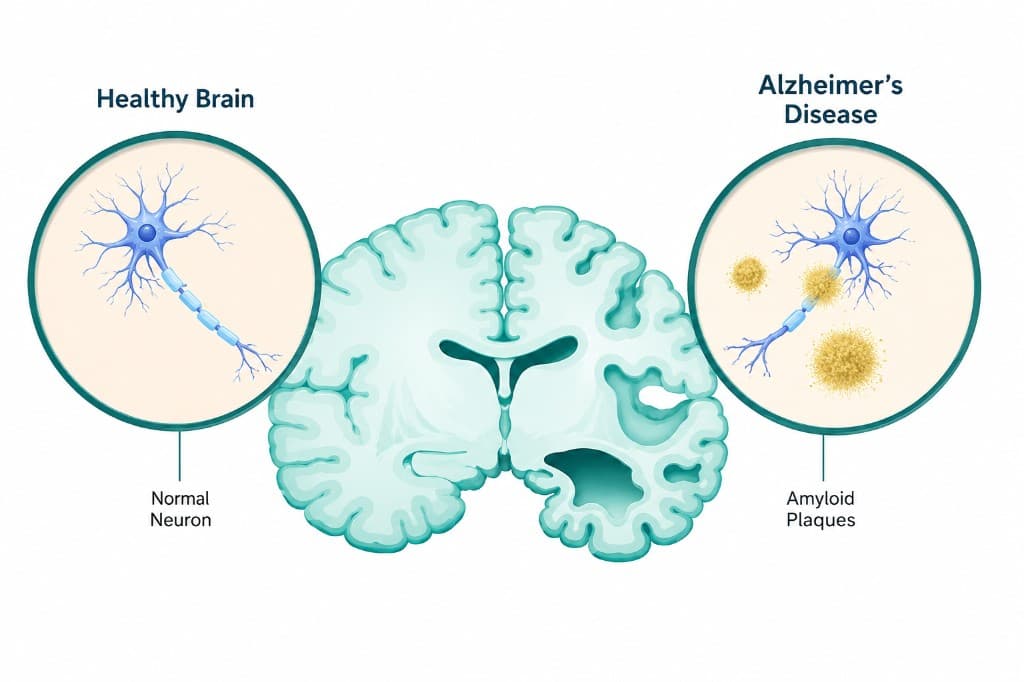
Healthy brain vs. Alzheimer's disease — amyloid plaques and nerve cell changes
Early recognition
Common Symptoms
Early recognition helps families seek timely evaluation and support.
Trouble Learning New Information
Difficulty retaining new facts, names, or recent events that family members notice first.
Misplacing Objects
Becoming lost in familiar places or misplacing everyday items more frequently.
Trouble Speaking
Challenges finding words, following conversations, or repeating questions.
Personality Changes
Shifts in mood, behavior, judgment, or social engagement over months to years.
Loss of Interest
Withdrawal from hobbies, routines, and activities that were once enjoyable.
Judgment & Safety Concerns
Problems with decision-making, finances, driving, or medication management.
Thorough evaluation
How Is It Diagnosed?
We coordinate a complete workup and explain results in plain language.
Health History & Exam
Complete medical and neurological evaluation with input from family when appropriate.
Laboratory Tests
Blood and urine studies to rule out reversible causes of cognitive decline.
Brain Imaging
MRI or CT when needed to assess structure and exclude other conditions.
Cognitive Testing
Formal assessment of memory, language, attention, and executive function.

Support for Patients & Families
There is no single simple test for Alzheimer's. When it is suspected, we coordinate a complete workup and explain results in plain language so families can plan next steps with confidence.
We partner with you on medications, safety, referrals, and community resources as needs evolve over time.
Questions & answers
Alzheimer's Disease FAQ
Common questions about memory care and evaluation at our Los Angeles clinic.
What are the early signs of Alzheimer's disease?
Early signs may include trouble learning new information, misplacing objects, difficulty finding words, changes in mood or judgment, and withdrawal from activities. Family members often notice these changes before the person themselves.
How is Alzheimer's diagnosed?
Diagnosis involves a thorough health history, neurological exam, cognitive testing, and sometimes laboratory tests and brain imaging to rule out other causes. There is no single simple blood test; we explain each step in plain language.
Is there a cure for Alzheimer's?
There is currently no cure, but medications and care plans can help manage symptoms and support quality of life. We partner with families on safety, medications, referrals, and community resources as needs evolve.
When should we schedule an evaluation?
If memory or thinking changes are affecting daily life, work, or safety, a neurological evaluation is appropriate. Call (310) 477-7201 or book online at our West Los Angeles office on Wilshire Boulevard.
We're here for you and your family. Contact us.
We're here for you and your family
Contact us to discuss evaluation options and compassionate neurological care in West Los Angeles.